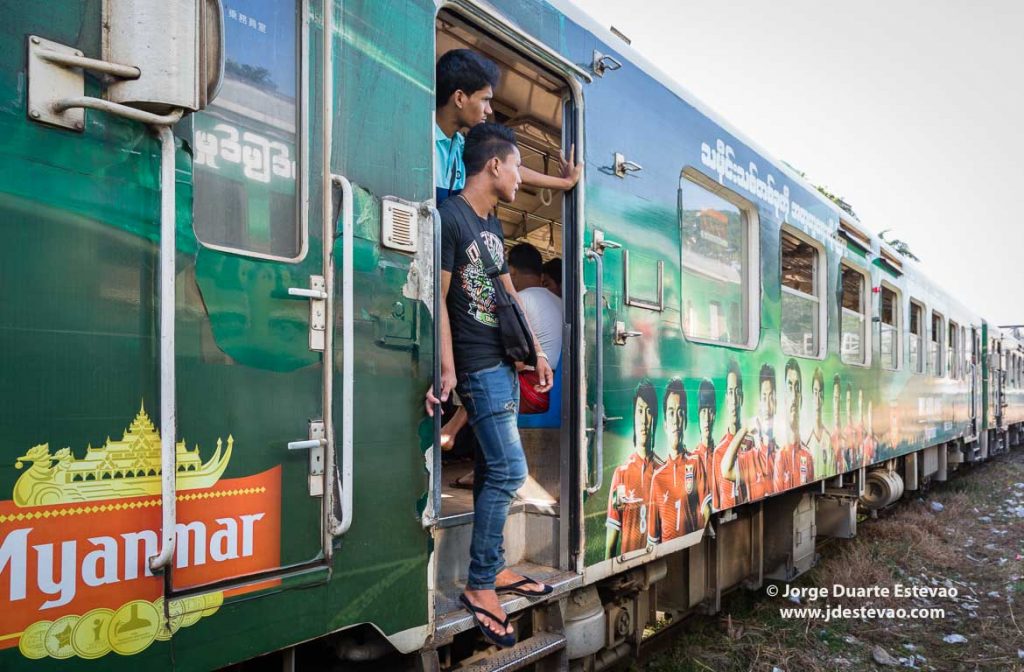
I think that for the first time in my travels, I'm more the object of attention from other people's gazes than the other way round. They notice me as if I've invaded this place, but they do so with curiosity, politeness and sympathy.
I try my best to pose for the locals, who use their mobile phones to photograph me. Once them, once me. Alternately we record moments, each with their own objective (and lens) on board the circular train from Yangon, in Myanmar.
This means of transport serves the metropolitan area of the former capital, circulating in loop for around 46 kilometres and 39 stations, linking satellite towns and suburban areas to the Burmese city. But this isn't just any passenger transport.
The circular train is more than just a cluster of carriages, it's a market, a meeting place, a transport hub for goods and people, it's even a shopping centre. Above all, this railway route in Yangon is authentic.
Beyond me, I see a couple of tourists, a couple inside the train and, outside, a Japanese man, camera in hand, standing on the disused railway lines parallel to the one I'm on.
I understand your persistence, as this is a photogenic train, just like the others in Myanmar. I too document your journey along the railway lines.
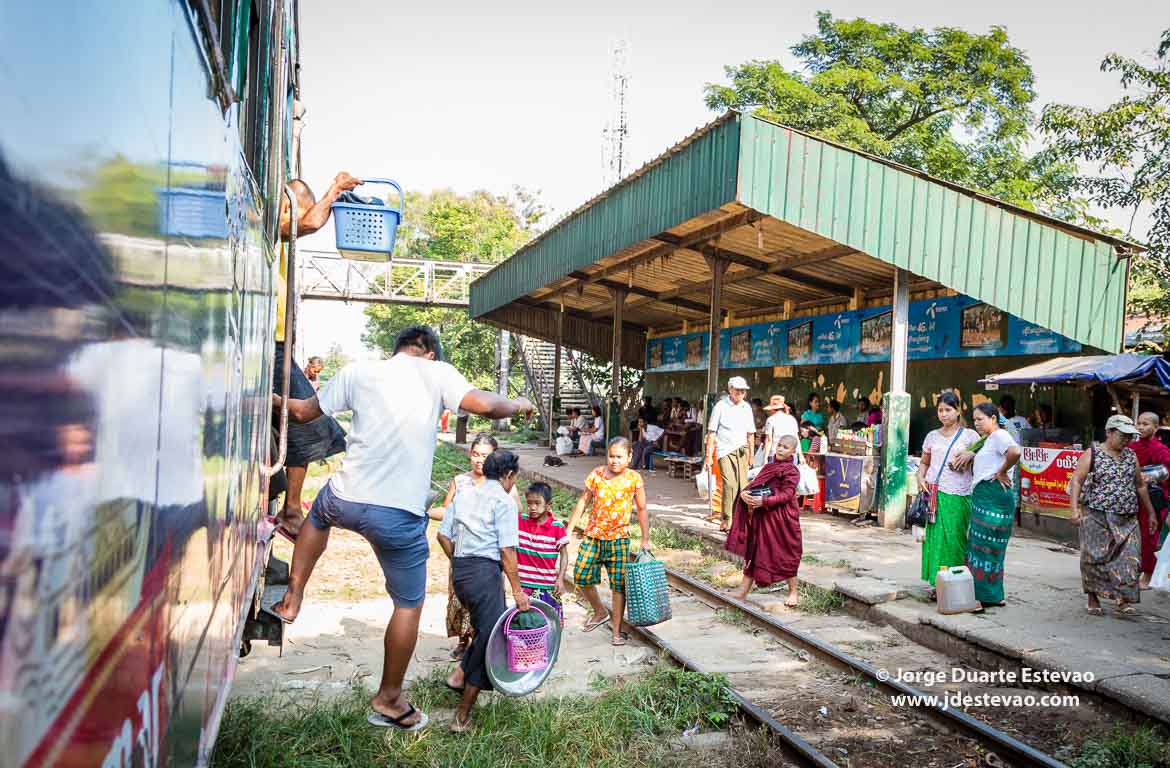
But that Japanese man is not alone. Accompanying him are dozens of people who cross the line at any given point, with 50-kilogram bags on their shoulders, bags of sweets and snacks, in transition to some market or street stall - and there are many on every corner in Yangon.
- Hotel in Yangon - Find the ideal accommodation in Yangon, with incredible deals and excellent facilities
- Take out travel insurance at IATI or Heymondo with a 5% discount
- Book the best tours, activities, transfers and entry to monuments in advance, without any unforeseen problems with GetYourGuide
Market on the move

Although there are around 40 stops on this Yangon circular train, the truth is that the speed of the train is so low that in many areas the number is multiplied by two.
Passengers and vendors come and go frantically, and it's impossible (unless you're a local) to tell which station or bus stop you're at, apart from a few where there are signs with the name of the stop.
Women, with heavy reed baskets on their heads, sometimes walk faster than the train itself. On leaving Yangon, we were stuck on the line for more than 20 minutes.
But I'm the only one surprised by this unscheduled stop. Young people take the opportunity to hang out of the doors and windows, to take advantage of any breeze that might calm the intoxicating heat.
It's only hot outside and not even the two or three fans running at maximum speed seem to have any effect.
Sitting in one of the doors, facing the sun, in one of the few empty spaces on the train, I drink water almost every minute. I'm offered a seat, but I cordially smile and decline the invitation. Between the option of being "crushed" between other passengers and being in the sun, I opt for the second option.
I take advantage of my strategic position to take a few more photographs, forgetting the blazing sun. I focus on the incessant movement of people along the line. Under the parallel railway lines, the same ones where the Japanese photographer was standing, I see clothes drying in the sun.
Poverty is still endemic in this country and, in the cities, the distance between the poor and the more privileged is enormous. Many live in improvised shacks in the streets, near the train station or along the line, beyond the walls that line the railway tracks.

Inside the train, vendors invade the carriages to sell newspapers, vegetables and fruit. Plastic bags with treats, trays with papaya slices, baskets with dozens of tangerines. At the stations or stops, people are cooking, selling meat sticks, homemade crisps, vegetables, fruit and water.
"Would you like some water?" a young woman asks me. I look at the reserves in my rucksack and I still have plenty, but out of sympathy I go and buy a bottle, after checking that it's closed.
This certification is essential because there is an alternative water market where bottles of untreated tap water are filled and sold.
Unfortunately, the failure to reuse millions of water bottles has serious consequences for the environment.
Tabbed windows open to rubbish
I'm shocked by a common attitude in Burma. Unfortunately, it's not exclusive to this Asian nation, but to much of Asia. While it's true that there are few or no rubbish bins, this can in no way be an excuse for the carelessness and ease with which plastic bags, bottles, cans - everything that no longer fits - are thrown out of the window.
In my opinion, this is an educational or civilisational issue, especially in a country that has only recently come out of isolation from the world and lived (lives?) for decades under a violent military dictatorship. In any case, it's an issue that urgently needs to be rectified.
I remember being in New Zealand, in a landscape of incredible, pristine beauty, in the fiords region of Milford Sound. There are no trash bins there. But two facts stayed strongly in my memory: the first is that I didn’t see landscapes polluted with plastic, paper, glass, or cans.
The second fact has to do with the notices explaining why there are no rubbish bins. Due to the remote location and the high cost of rubbish collection, all visitors are asked to take all their rubbish with them until they find a place to dispose of it.
Restless plastics on our plates

Throughout the urban, semi-urban and rural landscape in which I circulate, not just in Yangon but throughout Burma, I see plastic bags spinning, bouncing, restless at the mercy of the wind.
Tens, hundreds, thousands more lie beside railway lines or in the small rice paddies where local workers, with water up to their waists, harvest one of the year's many crops. However, the lives of these plastics don't end there.
A deficient waste collection and management system - combined with the enormous quantities produced daily (more than two thousand tonnes of rubbish a day in Yangon) - results in the accumulation near the railway and homes. These improvised dumps burn slowly, often without human intervention, due to the direct action of the sun.
Continuous exposure to the strong heat causes the release of gases and fumes that cause serious respiratory problems and associated illnesses, particularly affecting those who live nearby and in poor health conditions.
It pollutes the landscape and, in part, my thoughts every time I look at that accumulation of plastic which, in many cases, will end up in the sea, in the food chain, in the stomachs of many animals and, at the end of this process, on your and my plate.
Scientists around the world warn that the amount of small plastic particles – invisible to the human eye – in marine life has substantially increased, much of it consumed by humans.
Inheritance without luxury
I notice that in a building where the paint has worn off, the window shutters are still as white as the immaculate white of a shirt I see hanging inside one of the houses, contrasting with the colourful curtain in the window next door.
On the disused lines, in the shadow of one of the stations, a metre away from where the train runs, a dozen boys play cards, while the adults next to them prefer to challenge tactics on the chessboard.
The carriages, sponsored by the flavoursome Myanmar beer, bear images of local footballers wearing the red jerseys of the national team of this former British colony.
The railway lines were the great legacy left by the British to the Burmese population. Although some of them were built more than 100 years ago, they still connect almost every part of the country.
Travelling by train in this Asian country is an adventure, but a great pleasure, where you smile all the time, socialise and share meals, buy and sell a bit of everything, listen to and tell stories, read newspapers and, above all, make new friends.
Note: I intentionally use both the names Burma and Myanmar to refer to the Asian country. Myanmar was a name unilaterally introduced by the military dictatorship, without consulting the Burmese people, and it is still rejected by a large part of the population. Visiting Yangon is essential on a trip to Myanmar.
Extra information
How to travel on the Yangon circular train
(how much it costs, how long it takes and where to buy tickets)
Yangon's circular train is one of the cheapest and most authentic ways to experience the reality of the inhabitants of Burma's great metropolis. Built in 1954 during the colonial era by the British, the train carries more than 100,000 passengers every day over a distance of around 40 kilometres. The train departs from Yangon Central Station, an elegant colonial building in need of revitalisation.
If you want to go on this fantastic and exciting trip, here's the essential information.
Where to buy a ticket for the Yangon Circular Train
Yangon Central Station - platform 7.
How to get to Yangon Station
I chose to walk to the station. There’s no better way to get to know a place than by walking and feeling the city’s pulse. On the way back, I took a taxi to the hotel where I stayed.
Ticket cost
200 kyats = 13 centimes. You read that right, 13 cents!
There are more expensive tickets for the air-conditioned carriages, but the windows don't open (you'll probably go with more tourists), you lose all the excitement of the "real" carriages and it's difficult to take photos. If I repeat this experience, I'll travel in the "people's carriage" again.
Duration of the journey
The whole circuit (46 kilometres) takes 3 hours, but you can get off at any time and jump on the train in the opposite direction. That's exactly what I did after about 1.5 hours.
Yangon circular train timetable
The Yangon Circular Train leaves Yangon Central Station every 45 minutes or an hour - until the end of the day. The trains travel clockwise (right) and anti-clockwise (left) along the railway circuit every day.
It's just a matter of preference, as you'll pass through the same places and end up where you started: at Yangon station.
6h10 (Right / Left), 8h20 (Right), 8h35 (Left), 9h30 (Right), 10h10 (Right), 10h45 (Left), 11h30 (Right), 11h50 (Right), 12h25 (Left), 13h05 (Right), 13h40 (Left), 14h25 (Right), 15h30 (Right), 16h40 (Left), 17h10 (Right)
Stations where the train stops
Yangon Central Station, Pagoda Road, Lanmadaw, Pyay Road, Shan Road, Ahlone Road, Panhlaing Road, Kemmendine, Hanthawaddy, Hletaw, Kamayut, Thiri Myaing, Okkyin, Thamaing, Thamaing Myothit, Gyogon, Insein, Ywama, Phawkan, Aung San Myo, Danyingon, Golf Course, Kyaikkale, Mingaladon Bazaar, Mingaladon, Waibage, Okkalapa, Paywetseikkon, Kyaukyedwin, Tadagale, Yegu, Payame, Kanbe, Bauktaw, Tamwe, Myitta Nyunt, Mahlwagon, Pazundaung.
What you need for this fantastic trip
You'll need your passport to buy tickets and cash to buy goods on board. You can take water, which you can buy at Yangon Station or inside the trains.
There are plenty of vendors with food and water, but be aware that there are no toilets on the train. Also take a big smile, because you'll smile a lot and they'll smile back.
Save time (and money)
If you want to immerse yourself even more in the local culture, optimise your trip and even save money, take part in experiences and guided tours in Yangon. Book the best tours and activities in advance. Skip the queues and get your entrances to monumentsYou'll have more time to enjoy your trip.
Restaurants in Yangon
More than once I've visited and savoured the local delicacies of the small Jana Mon Ethnic Cuisine restaurant in Yangon. I recommend the main course of minced beef, chicken or pork with lemongrass for 3,500 kyats (€2.20) half-price and €4.70 a portion. Also try the fish or pork curry for the same price.
Address: 119 Nandawoon Street, Use That Shae Quarter
Visa for Burma
Unlike before, you can apply for a visa to Burma online and should be ready within three working days. The visa is valid for three months and you can stay in the country for a maximum of 28 days. The cost of a Myanmar visa is 50 dollars (2018).
How to get to Yangon
You can fly to Burma with Emirates for about €700. Another option is to fly to Bangkok and then catch a low-cost flight to Yangon. Use Skyscanner to compare the various options and prices.
I flew from London with Qatar Airways, and I recommend this route as the journey is evenly spread, with a stop in Doha, in Qatar. From London, there are also cheaper solutions with Air China (500€), although they involve much longer flights.
Hotel in Yangon
I stayed in the centre of Yangon and I highly recommend the Lavender Hotel. The facilities are comfortable, the location is perfect - just a few minutes' walk from Yangon's main tourist attraction, the Shwedagon Pagoda.
In fact, I recommend that at sunrise and sunset you go up to the hotel terrace and watch the sun illuminate the gold and diamonds of this fantastic monument.
It also overlooks a monastery of monks and near the entrance there is an incredible street market where you can get lost and enjoy yourself for many minutes.
Other alternatives for overnight stays in Yangon
- The Loft Hotel Downtown
- The Strand
- Pan Pacific Yangon
- Hotel G Yangon
- Yangon Excelsior
- Hostel President
Travel Insurance
Never travel without travel insurance. I recommend IATI Seguros or Heymondo (if you use either of these links you get a 5% discount). They are the best travel insurance (and the cheapest) and have Covid-19 protection.
Whenever you want to book a flight, a hotel or buy travel insurance, use the platforms I recommend and trust. All you have to do is click on the links below before researching your trips.
You don't pay extra for using these links.
- Hotel in Yangon at the best price
- Travel Insurance at IATI or Heymondo (5% discount with this link)
- Cheap flights for your next trip
- Rental car with reduced rates
- Bank card without commissions for travelling
- Store your luggage safely and cheaply
- Photography workshops — learn photography with me
Note: This text may contain affiliate links, but you don't pay more for using any link (and you can even save money). Guaranteed!
I organise and lead group trips to destinations I know well. And I only travel with small groups (maximum 12 people).
I've been to 60 countries, so if you have a trip in mind with a group of friends, family or work colleagues, contact me and I'll be happy to plan, organise and lead the trip you want. The itinerary can be customised, as can the budget and activities.
See the travel calendar and sign up or tell me where you want to travel as a group and I'll take care of everything.