The Viñales region produces everything: coffee, mangoes, vegetables and, of course, tobacco, lots of tobacco. In fact, it was Fidel Castro's favourite area of Cuba. It's from the Viñales Valley, in the province of Pinar del Río, that the best Cuban cigars come from, such as the Monte Cristo or Cohiba - the latter of which was allegedly favoured by El Comandante.
Guided tours of the Vale de Viñales usually start at around eight or nine in the morning. However, I spoke to my host, Bladimir, on the day I arrived, and within a couple of hours he had already contacted a guide willing to wake up much earlier than usual. The walk would start at 5.30 in the morning.
If you've read some of my travel stories, you'll have noticed that I don't like travelling anywhere where I have to constantly ask permission to pass or simply to see the sights.
I prefer to go earlier and enjoy the sites with fewer tourists and more peace and quiet. However, this time the main reason for starting the tour well before sunrise was the quality of the light.
Photographing in Viñales in the early hours of the morning is absolutely divine. I wanted to capture the first yellowish or orange tones breaking through the typical blanket of morning fog that takes over the valley at certain times of the year. And for that it was vital to get out of bed early, very early.
This unexpected request of mine actually favoured Juan, my guide, as he was going to finish his walk through the Viñales Valley at around 9.30am and at 10am another group of tourists was going to set off to explore the region. The wake-up call was worth it for both of us early.
- Hotel in Viñales - Find the ideal accommodation in Viñales, with incredible offers and excellent facilities
- Take out travel insurance at IATI or Heymondo with a 5% discount
- Book the best tours, activities, transfers and entry to monuments in advance, without any unforeseen problems with GetYourGuide
Unblinking beauty in Viñales
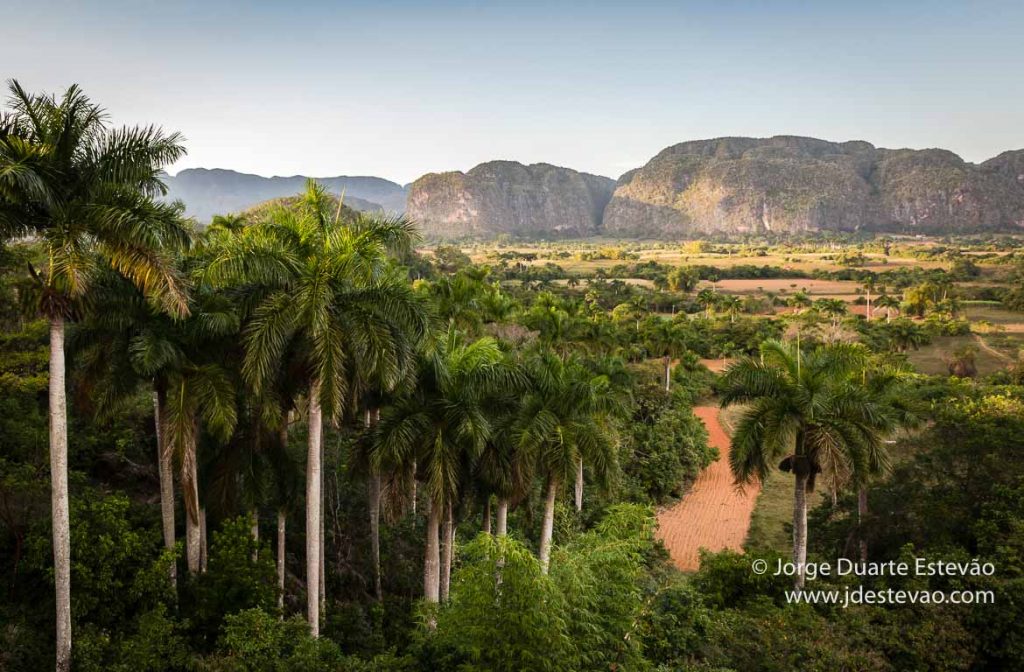
The Viñales Valley, in the province of Pinar del Río, is surrounded by mountains and the landscape is interspersed with rocky areas. The beauty is such that UNESCO has inscribed the Viñales Valley on its list of World Heritage Sites.
The night is still cold and we continue sleepily. First, through the alleyways outside Viñales, where half-lit lamps help us see the way. We're not the only ones there, as several peasants (farm labourers) were getting ready to start their day's work. Others waited patiently for the "colectivo", i.e. the transport to the agricultural fields.
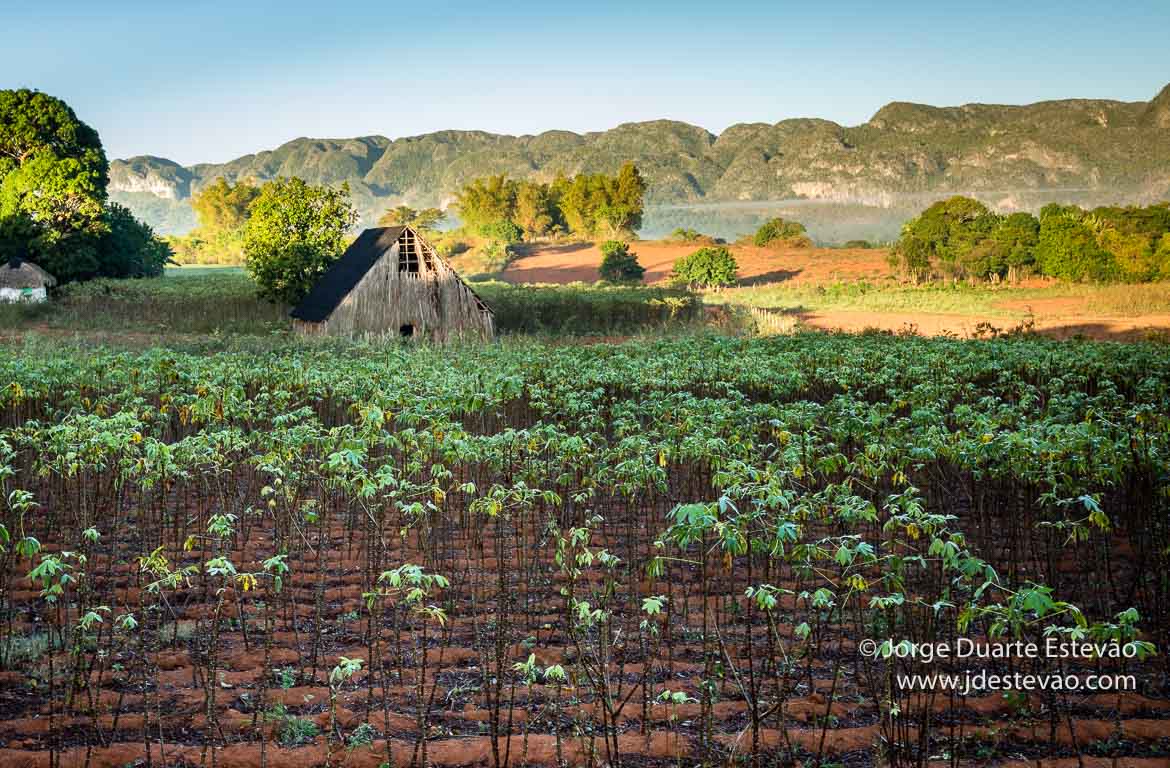
We walked at a hurried pace on a still very dark night, with no moon and only the help of a torch. We follow narrow paths, where our footsteps can be heard on the soft earth, moistened by the fog. I can smell that characteristic smell of wet earth, as if it had rained hours before. Maybe it did rain.
The terrain is rough and sometimes I feel it slipping away from my feet. Gone are the paved streets, bicycles and cars. Here, it's us, nature and little else. Up above, in the clear sky, the stars watch our steps. Down below, the dogs bark, but our "caravan" passes by.
"Oi, Oi, Oi," my guide suddenly shouts. I thought he'd had some temporary delirium, but no. He was just shouting to his brother who, in the distance, was getting the horses ready to go out for the first sightseeing of the day. I can't see him or the horses, but I hear the reply from the other side of the bushes. "That's finca my brother's," Juan explains to me.
Horse riding through the Viñales Valley is one of the most popular ways to explore the Pinar del Rio region, between the mountains and the plateau. This is an area of fertile land, enhanced by a humid microclimate. In the heart of the valley, temperatures drop much lower than in the town of Viñales and Juan assures me that "it's cold". Of course, in Cuba, cold is relative. The same cold (14°C) is mild weather in many other places on the planet.
"I think it went down to 7°C one year," he says. "But not as cold as in the mountains of Venezuela," he adds, while telling me that he worked there for four years. "I needed work and I went. The government allowed it, I went to Venezuela and came back to Cuba," Juan says proudly.
For many years, Cubans were allowed to leave the country to work, but many of them no longer return to Cuba due to the precarious situation and the communist regime.
"Here in Cuba, if a Cuban knows mechanics but can't get a job in that area, he goes to work in a restaurant kitchen or does something else. In Venezuela, it's not like that. They prefer to stay put. Venezuelans don't like to work".
And he tells the story of a friend who needed his car repaired in Venezuela and the local mechanic turned him down because, allegedly, he had already earned enough for several days with another recent client.
Viñales Valley hills on fire
The worn tracks are shared by walkers, locals and horses. I notice that a dog has been following us silently since we left the town of Viñales. Could it be a member of the Cuban secret service in disguise?
Darkness rises from the valley and the walls of the lomas, or hills, "catch fire". The first shades of orange are already appearing behind the Organ Mountains and a glimpse of the fog banks that took me there. With my camera ready, it's time to record this sublime moment.
A pair of vultures flies in a constant circular motion, perhaps to feed on some other animal that has suffered during the night.
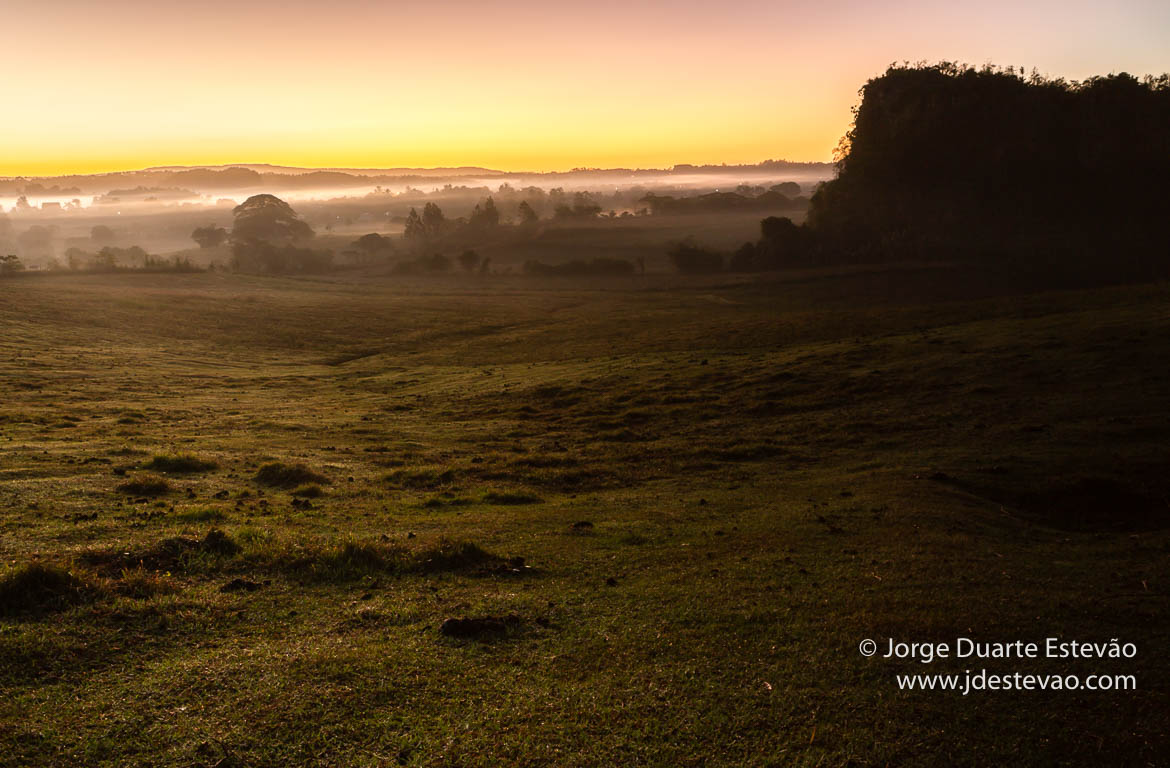
I stop at the edge of a huge old ceiba tree - perhaps over 30 metres high. According to Wikipedia, this genus of trees is found in various tropical areas, such as Central America, South America, the Caribbean, West Africa and Southeast Asia.
Next to the wide trunk of this ceiba, an old wooden cart with car tyres rests abandoned or just temporarily forgotten.
We cross a fence and our best friend, "the spy dog", follows us too. We pass two huge cattle who, even sitting in the pasture, can't stop ruminating.
On the left-hand side, another bovine drags a man in his 50s, wearing a fur hat with wide brims - in the style of the cowboy. He's travelling along a path opened up by rainwater and on top of a metal cylinder. "Taxi, taxi, taxi," Juan shouts, while smiling and the cowboy gives the bovine an indication to stop walking.
"Hola soy Mario," he says to me, and then questions the reasons for such an early morning visit. "What are you doing here so early? Aren't you dancing today?" Juan laughs, picks up his mobile phone, selects a song and starts to dance a little. We all laugh. That's how it is in Cuba: good humour and music are part of every moment.
Puente de los campesinos in Viñales
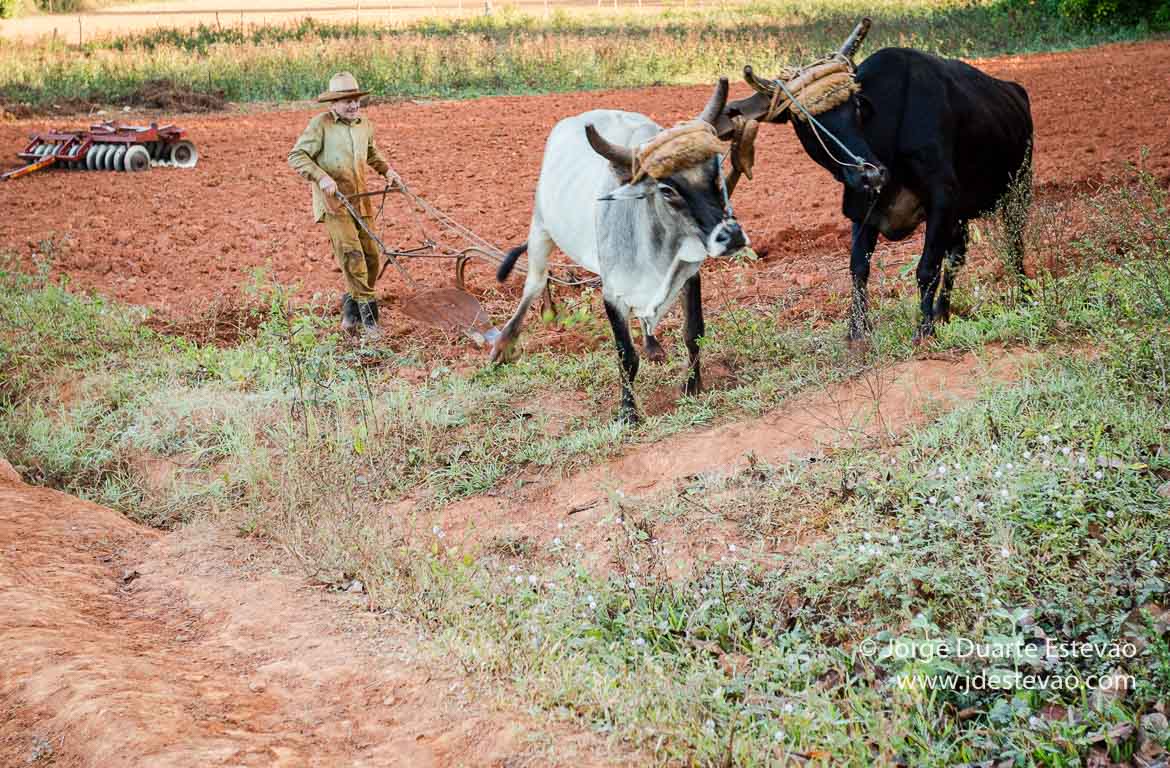
Mario fetches water from a well a few kilometres down the road to feed his cattle and use for irrigation. In Cuba, there is no innovation and everything in agricultural work is done using the sweat of the labourers or almost primitive tools. Fields are ploughed using animals such as donkeys, horses or large oxen. As was done in Portugal dozens of years ago.
One of these animals disobeys its owner and is immediately reprimanded, while the latter explains to us that it is imperative to start work early in order to take advantage of the soil's humidity and plough the land more easily. Beans, potatoes, sweet potatoes, tobacco or sugar cane are planted.
The fertile land is also used to grow mango trees, the fruit of which is harvested from April onwards.
Mario is already a long way down, sitting on his water cylinder turned into a transport. The Viñales Valley is beautiful, breathtaking even, but I'm starting to feel the weight of the photographic equipment on my back after another three hours of walking. And although the morning has only just begun, the heat is already almost unbearable.
I cross almost dry streams, between paths with puddles, mud and damp earth and my trainers take on a muddy orange colour. A metal bar acts as a primitive bridge to cross the stream, which overflows in the rainy season. I baptise it as the "Puente de los campesinos".
Cuban tobacco - the essence of a region
Despite the diversity of crops in this Cuban valley, most of the land in the Viñales Valley is occupied by tobacco plants - perhaps because it is the most profitable. However, 90% of the profits are handed over to the government and what remains is given to the workers to compensate for their hard work and long hours under the merciless sun - as in the example of campesino Mario and other campesinos across the island of Cuba.
The tobacco plant is heavily dependent on the climate, perhaps more than any other crop. And it's a labour of patience, as a small tobacco producer in Viñales explained to me. From the 350,000 or so tobacco plants harvested, around 3,500 Cuban cigars or "puros", as they call them in the country, are produced.
The cigars are then handed over to certain companies who label them and classify them according to quality, such as Cohiba or Monte Cristo. Sometimes the process can take a year - from the moment the seed is sown in the ground to the moment you can smell and light the cigar.
The leaves are usually ready to harvest in three months, although the drying process is slower. This is done in a hut with a zinc roof, where workers spray them with flavourings - such as honey or vanilla - and they are pressed for several weeks.
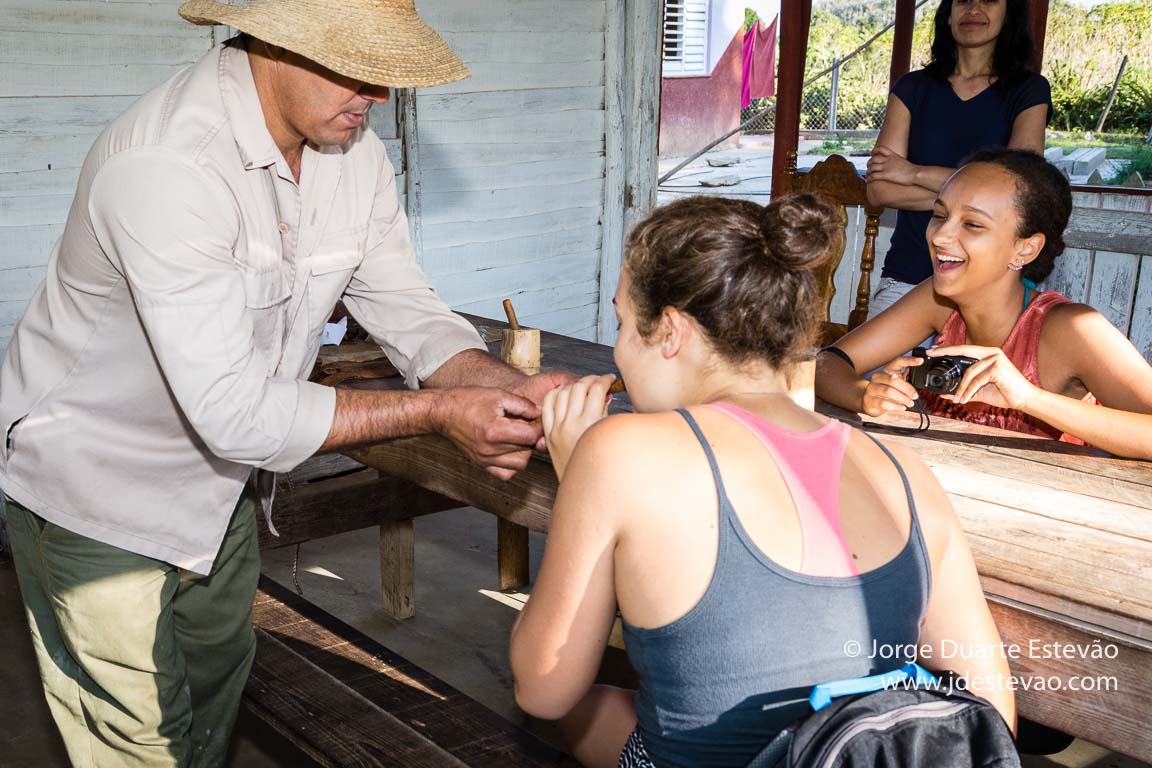
The producer shows me how the leaves are transformed into a cigar that can later be smoked. One of the essential steps is the removal of the thread containing the nicotine - so that the cigars don't become addictive.
Even though I haven't had breakfast yet, I accept the challenge of trying a cigar in the morning. I'm advised not to inhale and to put a drizzle of honey on the end that sticks to my lips to moisten the cigar and intensify the flavour.
Even though I'm not a smoker of tobacco, cigars or any other type of cigarette, I can identify an intense and pleasant aroma. How many of these cigars did Fidel Castro smoke in his lifetime?
The revolution in Cuba took place more than 50 years ago, but the country is far from progress, modernity and even having the infrastructure to receive an invasion of tourists, as I realised after the opening of flights from the USA.
With Obama, Cuba seemed to be getting a new lease of life, but with Trump's entry, there's been a setback. The only wind of change, for now, is in the heavy sky when a deluge invades the Viñales Valley, seeming to cry - on my farewell day.
Extra information
How to get to Viñales
There are several ways to get to Viñales. By bus, using the services of the Viazul transport company, you can travel from Varadero or Havana to Viñales. You can buy tickets online and the journey takes around 3h30 from the capital and four hours from the beaches of Varadero. The cost is 12 dollars (2018).
Another way of travelling to Viñales is by taxi. If, like me, you're staying in a private house, ask your host and they'll be sure to help you find a taxi to make the journey. You can do this individually (more expensive) or in a "colectivo", which is cheaper and recommended.
I've always travelled this way in Cuba, I've never had any problems and I've even met other fellow travellers. For example, I travelled in a colectivo from Havana to Viñales and then from Viñales to Trinidad. The price varies depending on the number of people sharing the transport, but in many cases it's cheaper than the bus.
Many companies, including Air Europa and Iberia fly to Havana. Use Skyscanner to compare flight prices for the time of your choice. It's one of the platforms I use and recommend.
Save time (and money)
If you want to immerse yourself even more in the local culture, optimise your route and even save money, take part in experiences and guided tours. Book the best tours and activities in advance. Skip the queues and get your entrances to monumentsYou'll have more time to enjoy your trip.
Restaurants in Viñales
If you've ever visited Cuba, you know from experience that after a few days in the country you'll be sick of "rice and frijoles". In Viñales or Havana you won't have much of a problem, as there is already a variety of restaurants. One of the restaurants in Viñales that I recommend is Paladar La Cuenca.
The food is good and the atmosphere cosy and modern. The price isn't one of the cheapest in Cuba, but as it serves international food you'll have to pay for the convenience. Alternatively, dine at the casa particular where you're staying. You'll probably eat well and pay less than in a restaurant.
Hotel in Viñales
Viñales has a huge range of places to sleep. You can use Booking to search for your favourite. I highly recommend Casa Paez. The owners are very friendly, the room is comfortable and the meals are excellent. If you stay there you won't regret it.
Travel Insurance
Never travel without travel insurance. I recommend IATI Seguros or Heymondo (if you use either of these links you get a 5% discount). They are the best travel insurance (and the cheapest) and have Covid-19 protection.
Whenever you want to book a flight, a hotel or buy travel insurance, use the platforms I recommend and trust. All you have to do is click on the links below before researching your trips.
You don't pay extra for using these links.
- Hotel in Viñales at the best price
- Travel Insurance at IATI or Heymondo (5% discount with this link)
- Cheap flights for your next trip
- Rental car with reduced rates
- Bank card without commissions for travelling
- Store your luggage safely and cheaply
- Photography workshops — learn photography with me
Note: This text may contain affiliate links, but you don't pay more for using any link (and you can even save money). Guaranteed!
I organise and lead group trips to destinations I know well. And I only travel with small groups (maximum 12 people).
I've been to 60 countries, so if you have a trip in mind with a group of friends, family or work colleagues, contact me and I'll be happy to plan, organise and lead the trip you want. The itinerary can be customised, as can the budget and activities.
See the travel calendar and sign up or tell me where you want to travel as a group and I'll take care of everything.