
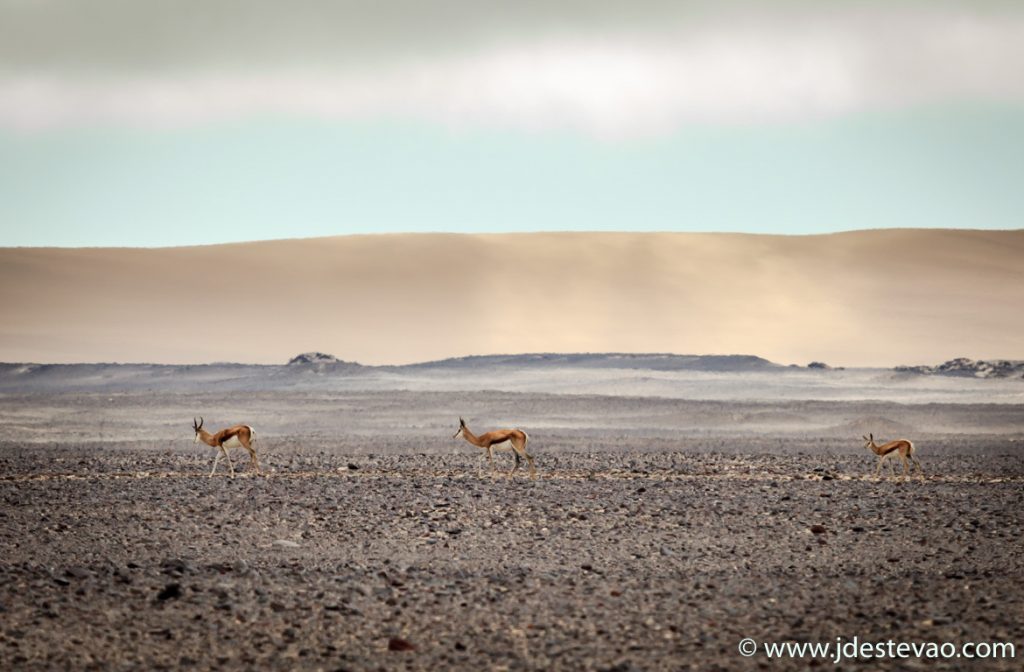
I listen to the silence. I keep quiet. I don't see anyone, nor am I being watched. I hold my breath. This silence is as vast as the territory that extends beyond my gaze. An immensity that seems to have no limits. I search, I insist, but it's still empty.
This white powder, which is salt, earth and road, creates the infinite sensation of an immeasurable horizon. The wind doesn't blow, but the skin shivers. The beauty is unusual and tragic, surreal and marvellous on my journey along the Skeleton Coast.
I like socialising, having dinner with friends, going on trips together, but today, here, isolated from the rest of the world, I feel happy.
This Namibia, this land that lives beyond other nations, transforms between desert plains, giant dunes, canyons, and parks — like Etosha — with wild species. All this is present in Namibia — one of the ten countries on the planet with the lowest population density.
- Hotel in Namibia - Find the ideal accommodation in Namibia, with incredible offers and excellent facilities
- Take out travel insurance at IATI or Heymondo with a 5% discount
- Book the best tours, activities, transfers and entry to monuments in advance, without any unforeseen problems with GetYourGuide
Fishing is more valuable on a trip along the Skeleton Coast

Reeds of three, four or more metres are placed in a vertical position with the help of an accessory attached to the front of the vans pick-up and jeeps, now stationary, in the car park of the remote Terrace Bay - the accommodation unit owned 100 per cent by the Namibian government and the only place I can stay in this part of the Namib Desert.
This area is particularly popular with sports fishermen, who take advantage of the waters along more than 300 kilometres of coastline. Some stay for more than ten days to try and catch huge specimens of fish. This is the cue for a chat with one of the staff at the tiny Terrace Bay petrol station.
I refuel more out of caution than necessity, since in this region of Namibia fuel stations are very scarce. It is essential to plan a trip to Namibia well.
During my research for this trip to this African nation, I saw plenty of warnings to fill up whenever possible, as some of the petrol stations in Namibia, as in other African countries, may be closed or have no petrol or diesel available.
That official tells me that it's rare to eat meat in these parts and asks me what kind of fish is eaten in Portugal. I try to answer with my in-depth knowledge from years of fishing - not in the sea, but on the plate. Sardines, horse mackerel, sea bass, sea bream, swordfish, sea bream or grouper, I reply.
He is impressed by so much variety and we continue the conversation with the topic I introduced - the sardine migration that takes place a little further down the coast, in the waters off South Africa.
The fantastic images of billions of sardines in the BBC documentary series "Blue Planet" and the agony of their escape from predators such as sharks and dolphins or sea lions come to mind.
Fleeing the sea to suffer thirst in the desert
I don't ask that man in his 40s his name, I'd say, and he doesn't ask me. After all, on the Costa dos Esqueletos there are faces without names, stories without memories, tragedies without manuscripts.
We are like that, two nameless faces, his for me, mine for him. Unlike the countless names that climb the walls inside Terrace Bay, of the tourists who have stayed there.
It was here in Namibia that we (the Portuguese and first Europeans) arrived in 1468, on an expedition led by Diogo Cão. I don't know if the Portuguese discoverers arrived in this particular area by mere accident or intuition, but I don't doubt that the feeling was one of shock.
I know I came here out of strong conviction. Almost as long as I can remember, Namibia was on my list of dream trips. That dream has come true.
The Skeleton Coast is an arid place where little or nothing grows and almost no animal life can adapt to the conditions of a wild coastline and the furious sands of the Namib - one of the oldest deserts in the world.
The name Portas or Sands of Hell summarises the Portuguese experience. Even so, desert lions, elephants and, above all, insects and reptiles survive here, roaming the sands at a steady cadence.
Stolen pattern, nose locks

The (bad) smell is so intense that it's practically impossible to breathe. I know that this time, at least on my trip along the Skeleton Coast, I can't accuse my fellow travellers. In fact, it's very easy to find the wrongdoer. Not one, but thousands.
Cabo da Cruz is a protected nature reserve, home to one of the largest seal colonies in the world. There they are born, reproduce (by the thousands), live and die (or are hunted by predators on land and at sea) and defecate in large numbers (and quantities). Want some advice? Don't miss out, but take something to cover your nose.
During his second expedition, between 1484 and 1486, Diogo Cão arrived at what is now known as Cape Cross, where he set up a standard establishing Portugal's rights over the region, while searching for the sea route to India.
The Cape of the Cross is a small peninsula in the South Atlantic, in western Namibia, on the C34 road, about 120 kilometres north of Swakopmund. The cross has become an important landmark to aid navigation. It is a stone pattern, two metres high, weighing 350 kg and with a cross on top.
The current cross is a replica erected by the Namibian government in 1980, since the original was taken to Germany by the Germans and has not yet been returned to Namibia. Three information stones, located on each platform, were placed there in 1986 to commemorate the 500th anniversary of Diogo Cão's second passage through Namibia.
Traveller without a fortune
One of the reasons I came to this coastal area of Namibia was to photograph iron oxide, or more specifically the corrosion caused by the natural environment. The Skeleton Coast is the graveyard of sailors and sea captains who didn't find their fortune and whose ships ran aground in shallow waters.
Many of the wrecks in this veritable ship graveyard are completely destroyed by the sun and the salty sea, but some are visible and can be seen and photographed up close. Many of these were swallowed up first by the sea foam and then by the patient invasion of trillions of grains of sand.
The Bushmen used to call the coast "The Land that God Angrily Created", while the Portuguese navigators referred to the Skeleton Coast as "The Gates of Hell". And like many sailors, I had no luck. My attempt to capture some of these images of stranded boats becomes impossible.
The cold water of the Benguela Current in the Atlantic Ocean collides with the dry, hot air of the Namib Desert. The resulting cold, dense fog extends out to sea.
It's impossible and not recommended, in these conditions, to try to drive the car along this road that I can't even see on this journey along the Skeleton Coast.
Frustrated, but still with a full soul, heading north towards Angola, yet never quite reaching it. Surrounded by the ocean sea on one side and sand sea on the other, I feel as if I have reached the end of the world.
After all, the end of the world is not in Argentinian Patagonia, but in Namibia. Even without fortune, with thirst and heat, I feel very happy here, at this end of the world, which is just a fantastic new world for me.
Extra information

There are a high number of road accidents, especially involving tourists. Many of the roads are unpaved and it is wise to travel at a moderate speed, around 80 kilometres per hour, keeping a distance from the vehicle in front.
It is highly recommended not to travel at night in Namibia, because there are many animals on the road. And it's not advisable to give a lift to strangers, although I've done it without any problems.
If you are visiting remote areas, check that there are petrol stations in operation, as they may be closed. Also, be prepared to change tyres because punctures are very common.
On my first visit to Namibia, I had to replace two tyres and repair another. Driving in Namibia is on the left, just like in the UK, and seat belts are compulsory.
Hire a car
If you have your own car, it's much easier. Choose to hire a car with Discovercars. This site allows you to compare prices and, in many cases, you can cancel the rental free of charge up to 48 hours before departure.
Money in Namibia
Credit cards are accepted in most commercial establishments, but you should carry cash with you. Not all petrol stations, for example, accept credit cards. The currency is the Namibian Dollar and has exactly the same value as the South African Rand, which is also accepted in Namibia. It is also essential to know how to go on safari in Africa without spending a lot of money.
I use the Wise card and the Revolut card to avoid bank fees and commissions. I always travel with both.
Visas for Namibia
Many citizens do not need a visa for Namibia for stays of up to 90 days, but the passport must be valid for at least 6 months after the date of entry into the country.
Safety in Namibia
Namibia is one of the safest countries in Africa. Although Windhoek is a calm and safe city, robberies have increased in the capital in recent years and basic precautions should be taken, particularly at petrol stations where you should always lock your car doors. Read more about safety in Namibia.
How to get to the Skeleton Coast
First of all, don't be intimidated by the name. The Skeleton Coast is a fantastic, beautiful place where you can really appreciate the simplicity and beauty of a place. But the Skeleton Coast is far from almost everything. Plan your travel itinerary to Namibia.
It is a remote area in western Namibia and can be included in a trip that features, for example, Sossusvlei, Fish River Canyon, the observation of thousands of flamingos in Walvis Bay, and then continuing, after visiting the Skeleton Coast, to Damaraland and the Etosha National Park.
Flights to Namibia
The most likely way to get to Windhoek is by plane. You can do this on a direct flight from Frankfurt with Air Namibia or via a connecting flight in Johannesburg.
There are flights from Lisbon and several European capitals such as London or Paris to Johannesburg (TAP, SAA, BA, Virgin, KLM, Emirates, Iberia) among other airlines. Use Skyscanner to compare the different options and prices.
From Johannesburg there are direct flights to Windhoek (about two hours) with South African Airlines, Air Namibia or British Airways. You can also fly from Porto with TAAG, with a connection in Luanda.
Transport in Namibia
You don't need an off-road vehicle to travel this salt road in Namibia, although it is more comfortable.
I opted for a 4×4 vehicle for the Skeleton Coast trip, with air conditioning and all the camping equipment such as tents that stand up on top of the car, mattresses, a fridge, satellite phone, three spare tyres and a 140-litre tank. I didn't do it to travel around this area, but my journey would only end at the Zimbabwe.
You can use the tool I use for car rentals. If you choose 4×4 vehicles, I recommend the company Advanced Car Hire, based in Windhoek. The entire service was remarkable, and you can even drop off the car at another location in the country or in another country and arrange for pickup—although this comes with an additional cost.
Where to stay on the Skeleton Coast
The most popular accommodation in Namibia, in rural and remote areas, is lodge and camping. There are few options in this area, but you can use this site to find the best places to stay.
I stayed at Terrace Bay, on the Skeleton Coast. It is a state property and offers comfortable facilities, from double rooms to beach chalets for several people.
Breakfast is sufficient and the food in the restaurant is tasty, especially the fish. It's a good place to spend a night, although the price is high given its remote location.
Travel Insurance
Never travel without travel insurance. I recommend IATI Seguros or Heymondo (if you use either of these links you get a 5% discount). They are the best travel insurance (and the cheapest) and have Covid-19 protection.
Whenever you want to book a flight, a hotel or buy travel insurance, use the platforms I recommend and trust. All you have to do is click on the links below before researching your trips.
You don't pay extra for using these links.
- Hotel in Namibia at the best price
- Travel Insurance at IATI or Heymondo (5% discount with this link)
- Cheap flights for your next trip
- Rental car with reduced rates
- Bank card without commissions for travelling
- Store your luggage safely and cheaply
- Photography workshops — learn photography with me
Note: This text may contain affiliate links, but you don't pay more for using any link (and you can even save money). Guaranteed!
I organise and lead group trips to destinations I know well. And I only travel with small groups (maximum 12 people).
I've been to 60 countries, so if you have a trip in mind with a group of friends, family or work colleagues, contact me and I'll be happy to plan, organise and lead the trip you want. The itinerary can be customised, as can the budget and activities.
See the travel calendar and sign up or tell me where you want to travel as a group and I'll take care of everything.


I'm a Portuguese "alfacinha" who has always loved travelling, getting to know other places, people and customs. Unfortunately, due to my limited resources, I've never travelled beyond the countries of Europe, Turkey and Ceuta!
I was delighted to read your text and I could almost see myself living the experience you describe, in the direct and real way you describe it. But, above all, I found the advice you give to "new adventurers" who also want to make the same kind of journey described in the text very interesting and right.
Thank you, and good luck and good health to keep going!
Thank you very much José for your kind words. I hope you have the chance to visit Namibia one day. It's a dream place. A big hug and happy travelling.